What a Cozy Gaming Setup Costs, in 3 Real Budgets for 2026!

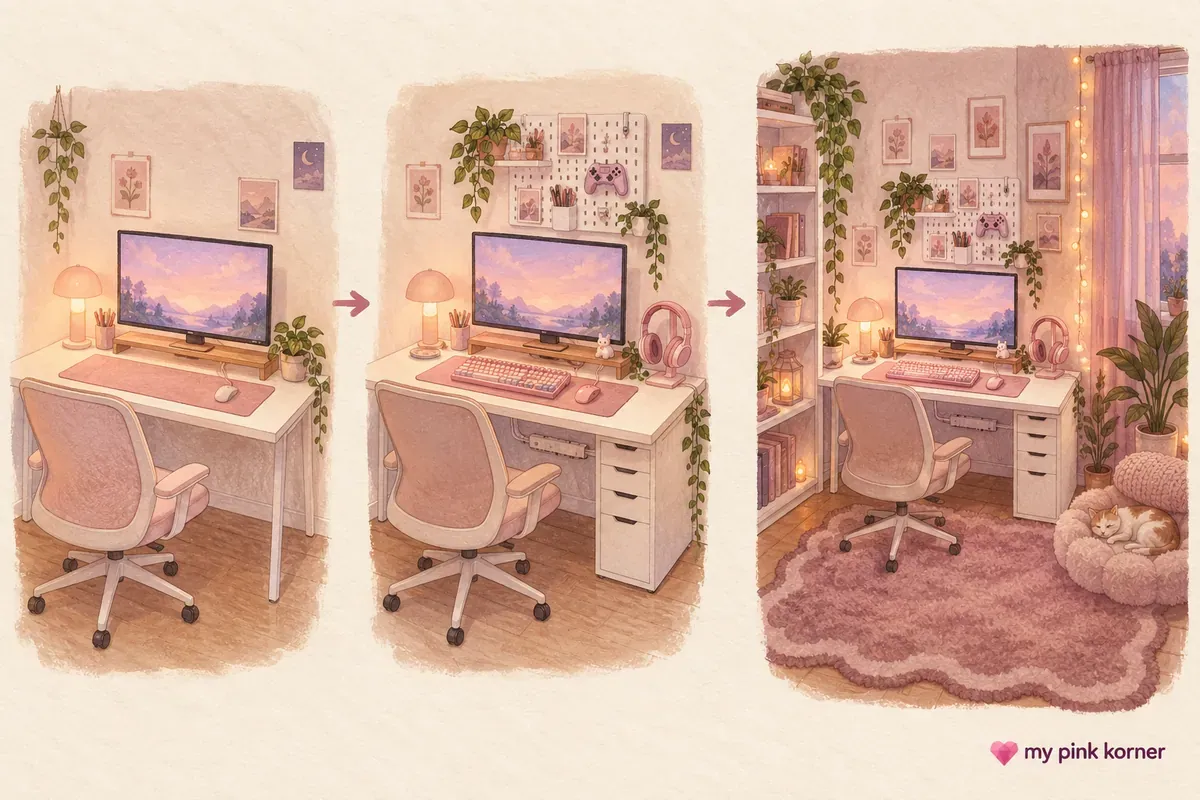
Search what a gaming setup costs and every answer is about a PC tower. Graphics card, prebuilt, case fans. The decor, the lighting and the textiles are missing from all of them. Those are the parts that make a setup cozy.
The cozy question is a different question. it's not what a machine costs. it's what do I add to what I already have, and in what order. Almost nobody starts from nothing. You have a laptop or a console and a desk of some kind, and you want the room around it to feel different.
So these three budgets start where people actually start. I have also put in the two things no cost page covers: what a setup costs to run per year, and the return-rate data that tells you which purchase is the risky one.
🎀 A closer look from the corner
Watch this post on Instagram ↗
Why every cost page answers the wrong question
The pages that rank are written by people who sell towers, desks or chairs. Each one scopes the answer to what it sells.
One major prebuilt retailer scopes its figures to a PC, a monitor and three peripherals. It then pushes desk, chair and lighting out of the total. Its own line admits those "can add several hundred dollars, or even thousands." The top commercial answer openly says it's not answering the whole question.
A large desk brand does cover desk, chair, peripherals and internet. On the version I read it had no coverage of decor, ambient lighting or textiles at all.
So here's the structural gap. Nobody prices the ambience layer, and the ambience layer is the entire subject. The one cozy-specific list that ranks gives fifteen line items with bands and deliberately never totals them, which is fair and leaves the reader without an answer.
For context on the scale of the category, US consumer spending on video games reached 60.8 billion dollars in 2025 according to industry figures compiled for the ESA. Hardware spend rose 9 percent while accessory spend fell 7 percent. People are paying more for fewer boxes, which is a useful thing to know before you start.
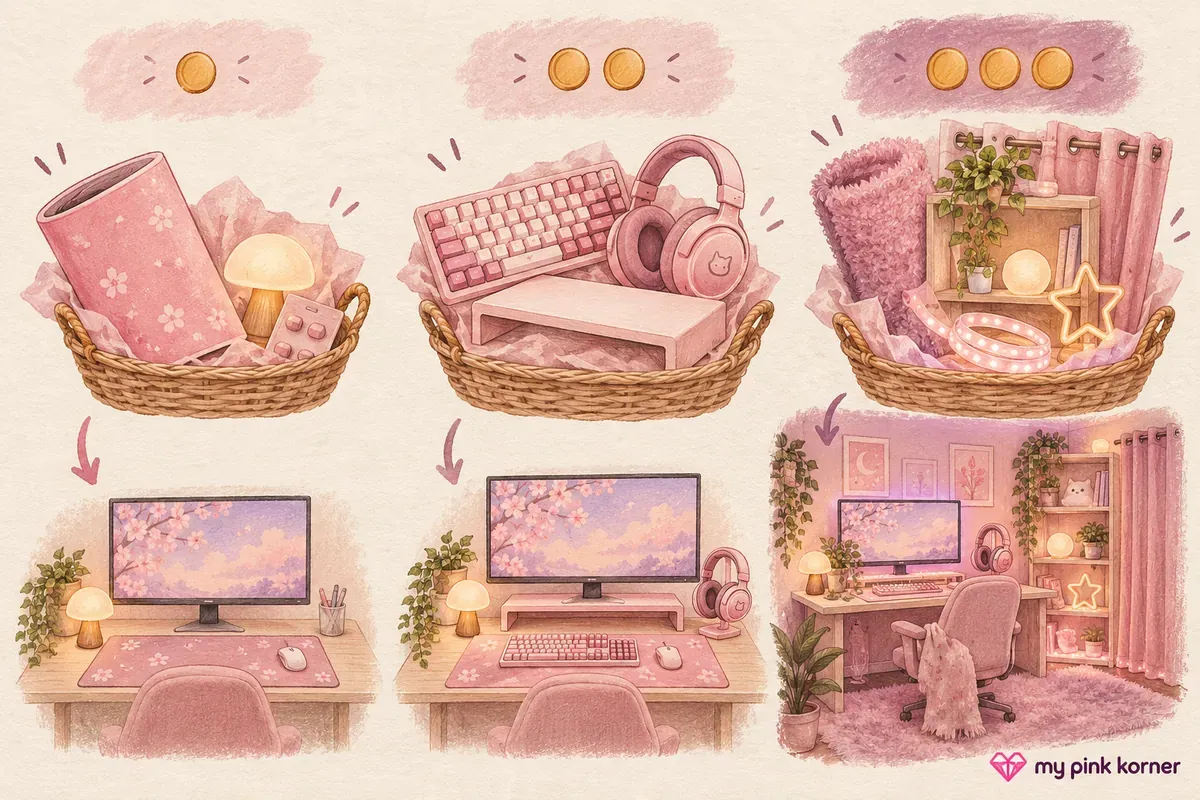
Budget one, you already have the desk and the device
This is the tier the whole internet skips, and it's where most people actually are.
You have a laptop, a console or a handheld. You have a desk, even if it's the wrong desk. Nothing here replaces any of that. In descending order of what it costs:
1. One ambient light. This is the largest single item in this budget and the one that changes the room. A Govee RGBIC floor lamp or the Floor Lamp 2 with a 2200 to 6500K range sits in a corner and lights a wall. A pink mushroom lamp or a cordless three-temperature desk lamp is the smaller version that lives on the desk.
3. A desk mat. The biggest visual change per dollar on this whole page, because it covers the largest flat surface you own. A felt XXL mat, a scalloped pink one or a leather-look YSAGi pad are the three finishes.
4. Comfort where you sit.A velvet meditation cushion or a flower plush floor pillow if you sit on the floor at all.
6. The small things.A cloud trinket dish, a pink headphone stand, a controller holder and artificial ivy garland are each small enough to buy without thinking about it, which is exactly the problem in the hidden costs section below.
The shape of this budget is lopsided on purpose. One lighting purchase is worth more than the other five put together, and every other item sat in a low band when I looked in September 2026. Buy two or three things at a time and this tier never feels like a project.
Budget two, upgrading the things you touch
This is where hardware enters, and the ordering changes completely.
1. The monitor is now the largest item by a distance. it's also, as we'll get to, the cheapest thing in the room to run. That contrast is the most useful thing in this article.
2. Keyboard and mouse. This is the tier where a mechanical keyboard makes sense, and there's a full comparison in the best pink mechanical keyboards under 100. A Womier WK68 60 percent, an AULA F75 75 percent or a DAREU EK75PRO in sakura pink are three of them. A pastel keycap set on a board you already own is the version of this that costs almost nothing.
3. Audio.The Razer BlackShark V2 X in Quartz Pink is the one I use and the Barracuda X is the wireless version. Everything else is in the pink gaming headset comparison.
4. Comfort before furniture. A cushion and a footrest before a new chair, every time. The chair is the single riskiest purchase on this page and I'd defer it as long as possible.
5. The enabling hardware nobody budgets for.A wooden two-tier monitor riser or a cloud-shaped wood stand, plus hubs, adapters and mounts. Individually trivial and collectively not.
Budget three, a whole room from nothing
Here the device dominates everything, and 2026 has been an unusually bad year to be buying one.
Every platform raised prices this year, and they published the numbers themselves:
| Console | Stated MSRP change | Date announced |
|---|---|---|
| PlayStation 5, disc | 499.99 to 649.99 dollars | 2 April 2026 |
| PlayStation 5 Pro | 699.99 to 899.99 dollars | 2 April 2026 |
| Xbox Series X, 1TB | 499.99 to 799.99 dollars | 1 August 2026 |
| Xbox Series S, 512GB | 299.99 to 499.99 dollars | 1 August 2026 |
| Nintendo Switch 2 | 449.99 to 499.99 dollars | 1 September 2026 |
Nintendo's own wording was plain: "Beginning on September 1, 2026, Nintendo of America will revise the MSRP of the Nintendo Switch 2 system in the U.S. from $449.99 to $499.99." Microsoft attributed its August increase to a roughly two and a half times rise in storage and memory prices. These are manufacturer announcements rather than shelf prices, and all of them move, so check before you buy.
The market-research view says the same thing from a different angle. Circana put the average selling price of a new gaming system at 542 dollars in July 2026, up 16 percent year over year, with unit sales down sharply. People are buying fewer consoles and paying more for the ones they buy.
If a console isn't the point, a handheld is the cheapest way into this. The handheld retro console guide covers the field, and an Anbernic RG35XX H or an RG34XXSP sits in a different order of magnitude from everything in the table above.
After the device comes the desk and the chair together, then the monitor, then the full lighting layer, then the room itself. A washable pink 5 by 7 rug, blackout pink curtains, peel and stick wallpaper and an 11-cube shelf are the room layer.
One framing that helped me. The US Bureau of Labor Statistics puts average household entertainment spending at 3,609 dollars a year. Everything a household spends furnishing the entire house came to 2,414 dollars. A full top-tier setup is a year of one of those budgets. That's not an argument against it. it's an argument for doing it in the order above rather than in one weekend.
What it costs to run, which nobody counts
Not one cost page I found mentions electricity, and it's the only cost that repeats every year.
The price input first. The US Energy Information Administration's September 2026 outlook puts the average residential retail electricity price at 18.20 cents per kilowatt hour for 2026, up from 17.30 cents in 2025. State rates vary a lot, so treat that as the national middle.
The draw. Digital Foundry measured a PS5 at the wall at around 201 to 232 watts in real games depending on model. Hydro-Québec, a utility publishing consumer guidance, puts both a PS5 and an Xbox Series X at 160 to 200 watts while gaming at 4K. Streaming video on the same hardware drops to 31 to 70 watts.
The arithmetic is yours to do and it's simple: watts divided by 1000, times hours a day, times 365, times 0.182. Three hours a day at 200 watts lands near 40 dollars a year.
Now the part that matters. The same utility states that about half of the electricity a console consumes is used when it's on standby. Instant-on takes an Xbox Series from about 1 watt to about 10. Turning that setting off is the single largest free saving available to a console owner and it takes ten seconds.
The monitor is almost free to run. The Department of Energy's federal energy programme puts an ENERGY STAR certified 27 inch 1080p monitor at 52 kilowatt hours a year, about 6 dollars by their own figure. The most efficient model available saves roughly 16 dollars over the monitor's whole life.
And the lighting is the smallest of all. The Department of Energy puts residential LEDs at at least 75 percent less energy than incandescent and up to 25 times the life. ENERGY STAR certified bulbs go further, rated at over 13 years. The cozy layer is the cheapest thing in the room to run, which is worth remembering the next time somebody tells you the lights are a waste.
The hidden costs, returns and the small-things tax
There are two costs nobody puts in the total, and the first one is measurable.
Returns. The National Retail Federation put total US retail returns at 849.9 billion dollars in 2025, with 19.3 percent of online sales returned. Compiled category benchmarks from the same period put electronics at roughly 8 to 15 percent and home and furniture at roughly 15 to 23 percent.
Read that again, because it changes what you buy first. Furniture is returned at about twice the rate of electronics. The desk and the chair are the risky purchases, not the keyboard. That matches the advice above to defer the chair, and it's the only evidence-backed reason I can give you for it.
The same research shows bracketing, ordering several versions intending to send most back, is now majority behaviour among online shoppers, up from around 40 percent in 2018. Buying wrong is normal. it's priced into the way the whole category works.
The small-things tax. The cozy list I keep coming back to has fifteen line items and no total, and every one of them sat in a low band when I checked in September 2026. Fifteen small purchases isn't a small purchase. Nobody notices, because each one is individually forgettable. The fix isn't to buy less, it's to decide the list first and then buy it, rather than adding one thing a week for a year.
Nothing here actually wears out, and that's the real hidden cost. A Razer optical mouse switch is rated at 90 million clicks. Mechanical keyboard switches are commonly rated for 50 to 100 million keystrokes. An ENERGY STAR bulb is rated for over 13 years. Almost nothing on a desk is ever replaced because it broke. it's replaced because taste changed, which is an argument for buying the shade you actually want the first time rather than the cheap version of it. That's the whole point of why some pink setups read as cheap.
When to buy, and what the discount data actually says
Two independent datasets looked at the 2025 holiday season and they disagree in a way that's useful.
Adobe Analytics, tracking 257.8 billion dollars of US online spend from November to December 2025, found peak discount depth in electronics at 30.9 percent off list, with computers at 23.4 percent and televisions at 24.3 percent. That's the deepest single discount observed.
DataWeave tracked around 80,000 individual products across Amazon, Walmart, Target and others. It measured the average rather than the peak. Consumer electronics averaged 14.6 percent off before Black Friday week, and gained only 2.6 percentage points more during the event itself. Home and furniture averaged 13.9 percent before, plus 1.7 points during.
Here's the finding. Most of the discount is already live in early and mid November. Waiting for Black Friday day gains you about two and a half points on electronics, which on anything in the cozy layer is a rounding error. The deep 30 percent headline exists on a small number of products and it's not what the average shopper gets.
What I take from it: buy the small things whenever. Time only the one large purchase, and even then mid November is as good as the last Friday of it.
What I'd buy first
The lamp, and then nothing for a month.
In budget one, lighting is the largest line item and the largest change. Everything else on that list still works a month later. Buying the light first means everything you add after it's being judged in the light you actually want.
Second, the desk mat, because it's the biggest surface in every photo and the cheapest large change there's.
Third, the cable pass. Free, and it's what makes the first two visible.
What I'd not buy first: a chair, a desk or a monitor. Those are the three highest-risk, highest-cost items and none of them makes a room feel cozy on its own. The chair in particular sits in the return category with the worst record in retail.
Starting from zero, the 12 things that actually matter is the same order with the reasoning attached. My own setup is what it looks like when it's finished. For free ideas while you save, 34 pink setup ideas has nine that cost nothing and the weekend version is two days of work rather than a budget.
If somebody else is paying, the cozy gaming gift guide is sorted the same way, with pink gaming gifts under 25 and gaming gifts under 50 as the two bands most of this lives in. Everything I own is on my faves and there's more about me on my about page.
Cozy setup cost FAQ, the questions I get asked most
How much does a cozy gaming setup cost?
It depends entirely on what you already own. If you have a device and a desk, the ambience layer is one lighting purchase plus a handful of small items. If you're starting from an empty room, the device is the biggest line item and console prices rose across all three platforms during 2026.
What's the biggest single cost?
The device, in every budget except the first. In the first budget, where you already own the device, it's the lighting.
What's the cheapest change that makes the biggest difference?
Turning the ceiling light off and putting one warm lamp on the desk. After that a desk mat, because it covers the largest surface in the room.
How much does it cost to run a gaming setup?
A console draws roughly 160 to 235 watts while you play. At the 2026 US average residential rate of 18.2 cents per kilowatt hour, three hours a day works out near 40 dollars a year. The monitor and the lights are a small fraction of that.
Does standby really matter?
Yes. Hydro-Québec states that about half of a console's electricity is used in standby, and instant-on takes an Xbox Series from about 1 watt to about 10. Turning it off is free.
What's the riskiest thing to buy?
Furniture. Home and furniture categories are returned at roughly 15 to 23 percent against 8 to 15 percent for electronics, so the desk and the chair are where people get it wrong most often.
Do cheap peripherals need replacing sooner?
Rarely for mechanical reasons. Mouse switches are rated in the tens of millions of clicks and keyboard switches at 50 to 100 million keystrokes. Things get replaced because taste changed, which is an argument for buying the colour you actually want first time.