5+ Pink Gaming Room Ideas That Work in a Rented Bedroom

Every pink gaming room article I've read is a desk article wearing a room title. Five headings about a desk and a chair, no heading for a wall, a window, a floor or a ceiling. The Pinterest boards filling the rest of the page are photos of rooms nobody can tell you how to build.
And all of them assume you own the place. Most of us don't. So the organising question here's what you can do to a room you have to hand back.
The checkable parts of this I checked. Manufacturer instructions, published light reflectance numbers and the pile height a chair caster can actually roll on.
🎀 A closer look from the corner
Watch this post on Instagram ↗
The walls, and the paint finish that decides everything
Every answer online to "does peel and stick wallpaper damage walls" is yes or no. The real answer depends on a variable almost nobody checks, which is the sheen of the paint already on your wall.
Tempaper, which makes the stuff, is explicit. It works on primed walls painted in eggshell, satin or semi-gloss. The company doesn't recommend it on matte, flat and low sheen paints.
The mechanism is the part that made me sit up. On flat paint, in their words, "the chalkiness of the paint can marry to the inks causing a not-so-clean removal." The wallpaper doesn't fail onto the wall. The wall fails onto the wallpaper. And flat or matte is the most common finish in a rental, because it's the cheapest to touch up between tenants.
Two more conditions from the same manufacturer. New paint has to fully cure first, on the timing printed on the paint can. And textured walls are out. On popcorn or heavy texture the company warns that bumps show through the paper, or that it'll not stick at all. Their own advice on orange peel texture is to put a sample up and leave it for several days before committing to a wall.
Prep, from the manufacturer: a damp cloth, then a one to one mix of isopropyl alcohol and water.
Wall decals have a stricter rule and it surprised me. Decal makers want you to wait at least 30 days after painting before applying anything, and they want eggshell. Flat and matte are too porous for the adhesive to bond. Gloss and semi-gloss are too slick and cause peeling later.
So the two treatments disagree. Wallpaper accepts eggshell, satin and semi-gloss. Decals accept eggshell and satin and reject gloss. Eggshell is the only finish both are happy with. Go and look at your wall at an angle under a lamp before you buy anything.
If the wall passes, a matte light pink peel and stick, a pink gingham or a pink and white stripe are three directions. Stripes do something to a low ceiling that a plain colour doesn't.
One thing to check before any of it. The wear and tear guidance most landlords work from lists nail holes in the wall as acceptable. It lists unapproved paint or wallpaper as tenant damage. Removable wallpaper is still wallpaper as far as a lease is concerned. Ask, or keep it to one wall you can restore. This varies by state and by lease, so treat it as the standard most landlords work from rather than as your rights.
The one pink wall rule, with a number behind it
A dark pink wall eats light, and there's a published measurement for exactly how much.
Light reflectance value is a 0 to 100 scale for how much light a surface bounces back, measured with a spectrophotometer against a formal standard. Paint companies publish it. Above 50 a colour reflects more light than it absorbs. Below 50 it absorbs more than it reflects.
Here are three real pinks with their published values:
| Colour | Light reflectance value | What it does |
|---|---|---|
| Farrow and Ball Setting Plaster | 57 | Reflects well over half the light hitting it |
| Farrow and Ball Nancy's Blushes | 55 | Just above the line |
| Farrow and Ball Rangwali | 25 | Returns about a quarter |
Swap Setting Plaster for Rangwali on four walls and you more than halve the light bouncing back into the room. If your whole setup is built on soft LED light, that's the highest-leverage decision on this page and nobody mentions it.
The rule I'd follow: deep pink on one wall, a pink above 50 on the other three. You get the colour you actually wanted and the room still lights up.
Fabric on the wall, the treatment that ignores all of this
A hanging fabric panel is the only wall treatment that doesn't care what finish your paint is, because it never touches the wall chemically.
It hangs from something. That something goes on bare painted wall, which is exactly what Command strips are rated for. No sheen test, no cure time and no chalky paint problem. It comes down in one motion when you move out.
A pink boho wall hanging or a pink mandala print covers a wall in one purchase. A large blush macrame hanging does the same job with texture instead of pattern.
It also fixes sound. A big piece of fabric on a hard wall is the cheapest thing you can do about a room that echoes.
The window, and why it matters more than the lights do
I spent months wondering why my pink light looked grey in photos, and the answer was the window.
Daylight is roughly 5000 to 6500 kelvin and enormously brighter than any light strip. With it in the room, coloured LED light is diluted to nothing. A photo of a lit pink setup taken in the afternoon shows a grey room with some pink dots in it.
Blackout and room darkening are different products and the numbers are published. Blackout blocks 99 to 100 percent of light. Room darkening blocks 70 to 95 percent, which sounds close and isn't. At 85 percent the room is dimly lit. At 95 percent it reads as properly dark. Only at 99 do you get near total darkness.
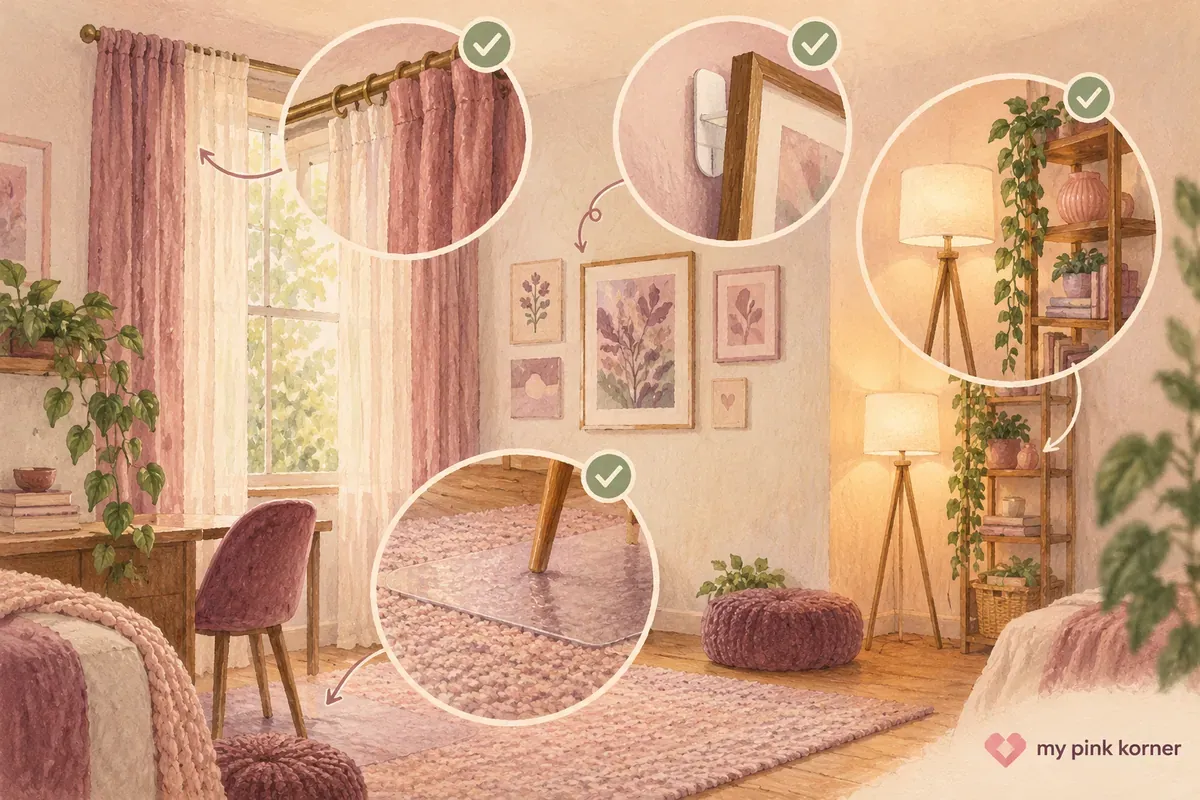
The measurement that decides whether it works: panels have to extend 6 to 12 inches past the window frame on each side. Miss that and you get what the industry calls a halo, which in practice is two bright vertical stripes down the edges of your window.
The rest of the numbers, from a curtain manufacturer's own guide:
| Measurement | Number |
|---|---|
| Rod height above the frame | 6 to 10 inches |
| Rod extension past the frame, each side | 6 to 15 inches |
| Fullness, blackout grommet or back tab | 1.5 times rod width |
| Fullness, sheer | 2 times rod width |
| Length, add for back tab | plus 1 inch |
| Length, add for grommet | plus 2 inches |
Worked through, a 100 inch rod with blackout grommet panels at 1.5 times wants 150 inches of fabric, so two 75 inch panels.
Light pink blackout curtains at 84 inches, a back tab 52 by 84 pair or a fully blackout pink pair at 52 by 63 are three sizes. Measure the rod before you buy, because the 1.5 times rule is the one people skip.
A tension rod is the renter's version. It works in a recessed window with firm parallel sides and fails on a long span with heavy lined curtains, leaving rubber end marks and pressure scuffs.
The floor, and the rug your chair can't roll on
The shag rug in every pink room photo on Pinterest is the reason your chair won't move.
Chair mat guidance sorts carpet into four bands by pile height. Commercial is a quarter inch or less. Low pile runs a quarter to three eighths. Medium runs three eighths to three quarters. High pile is three quarters of an inch or more, and a shag rug is comfortably in that band.
You can measure yours in ten seconds, and the method is the best trick in this article. Open one end of a paper clip, push it into the rug and pad until it hits the floor, then measure the part that went in. That's your pile height.
If it's above three eighths of an inch, a desk chair will fight you. The fix is either a lower pile rug or a 36 by 48 inch chair mat over the top, which is the standard size for a desk and chair. A clear alternative in the same size does the same thing.
Rug size for a desk, which nobody states either: a small desk or work nook wants a 4 by 6 or a 5 by 7. A standard desk wants a 5 by 7 or a 6 by 9. Plan for 24 to 28 inches of rug behind the chair, which is the number that decides whether the back legs fall off the edge when you push away from the desk.
A washable pink 5 by 7, a light pink 5 by 7 and a non-slip pink area rug in the same size all land in the right band for a desk.
Now the idea I want to talk you out of. Peel and stick floor tile isn't the floor version of peel and stick wallpaper. The manufacturer's own instructions say it's built to be permanent. It needs plywood, primed concrete or underlayment. It'll not go over floating laminate or linoleum. It needs 48 hours to acclimate at 65 degrees or above. Removal can damage the surface underneath and leave residue, and it's not approved over carpet at all. In a rented bedroom the honest answer is a rug.
Shelves, storage and the strip that'll not stick to wallpaper
There's a hard conflict here that no competing page mentions, and it'll cost you a wall if you do it in the wrong order.
3M's own guidance: Command products work on painted walls where the paint has cured at least 7 days, and on finished wood, tile, glass and metal. They're not recommended for wallpaper, brick or rough concrete. Heavily textured surfaces are out too, because the adhesive can't make full contact.
So if you peel and stick a pink accent wall, you have just disqualified that wall from Command strips. Either hang the frames and shelves on bare painted wall, or wallpaper a different wall from the one you're hanging on. Decide which before you buy either.
The weight tiers are published: 1, 3, 5, 8, 15 and 20 pounds. The 15 pound large picture hanging strips hold 15 pounds and carry a stated maximum frame size of 24 by 36 inches, which is the spec people miss.
Removal is a technique, not a tug. Pull the tab straight down slowly along the wall, never toward you. 3M blames paint coming off on paint that was weak, old, uncured or damaged. The other cause it names is pulling the strip out instead of down.
The ceiling, the corners and the door
The ceiling is free real estate and almost nobody uses it.Fairy lights at 33 feet or globe string lights run the perimeter of a small bedroom and change the whole light level at night. Warm white curtain lights or a 300 LED curtain with a remote turn one wall into a light source rather than a lit surface.
The corner is where a room gets depth. One tall light in a corner does more for how a bedroom reads than three things on the desk. A Govee floor lamp with a 2200 to 6500K range, the basic RGBIC version or a Noguchi style paper floor lamp all do it differently. The paper one is the warmest and the least gaming-looking.
Wall panels are the version of this that goes above the desk rather than beside it, and Nanoleaf Blocks are the current shape of that idea.
For the door and the dead wall beside it, artificial greenery does more than it should. An ivy garland 12 pack runs along a curtain rail or a door frame and softens every hard line in the room.
Seating that's not the desk chair
A second place to sit's what turns a desk in a bedroom into a room you spend time in.
A floral pink bean bag, a giant corduroy one or a faux fur cover you fill yourself are three routes. The cover-only version ships flat and is the one to buy if you're in a shared house and moving again in a year.
Smaller and cheaper, a velvet meditation cushion or a flower plush floor pillow give you somewhere to sit without committing floor space permanently. A handheld is what a second seat is for, and the handheld consoles I actually play is the shortlist.
What I'd do first
Curtains, before anything else in the room.
They're the only change that alters the light twice a day. They're the reason your LEDs read as colour on camera, and they need no permission from anyone. Measure the rod, apply the 1.5 times rule and add the 6 to 12 inches each side.
Second, the corner lamp. One tall light on the far side of the room gives a small bedroom depth that no amount of desk lighting can.
Third, the paper clip test on whatever rug you already own. Buy a mat if it fails. It costs nothing to find out and it's the difference between a chair that rolls and a chair that doesn't.
What I wouldn't do: peel and stick floor tile in a rental. Wallpaper on flat paint without testing a sample first. Command strips on a wall you have just papered.
If the desk itself is still the project, the 12 things that actually matter is the buying order and my own setup is every object on mine. For the version of this at desk scale, 34 pink setup ideas has nine that are free and pink setup ideas that don't look cheap is about finish and material.
For the light specifically, my cozy lighting guide is the three-layer formula I use at the desk. The weekend version is the two-day plan. Everything I own is on my faves and there's more about me on my about page.
Pink gaming room FAQ, the questions I get asked most
Does peel and stick wallpaper damage walls?
It depends on the paint underneath. Manufacturers recommend eggshell, satin or semi-gloss and specifically advise against matte, flat and low sheen paint, because the chalkiness of flat paint can bond to the inks and come away with it.
Can I use Command strips on wallpaper?
No. 3M doesn't recommend Command products for wallpaper, brick or rough concrete. Heavily textured walls are out as well. If you paper a wall, hang things on a different one.
How long should I wait after painting?
Command asks for paint cured at least 7 days. Wall decal makers ask for at least 30 days, and up to four weeks for larger wraps. Peel and stick wallpaper asks you to follow the cure time on the paint can.
Will a dark pink wall make my room darker?
Yes, measurably. Light reflectance value runs 0 to 100 and anything under 50 absorbs more than it reflects. Farrow and Ball's Rangwali sits at 25 and Setting Plaster at 57.
What's the difference between blackout and room darkening curtains?
Blackout blocks 99 to 100 percent of light. Room darkening blocks somewhere between 70 and 95 percent. Both need to extend 6 to 12 inches past the window frame on each side to avoid light leaking down the edges.
Why will my chair not roll on my rug?
Pile height. Anything at three quarters of an inch or more is high pile and casters struggle. Measure with a straightened paper clip pushed to the floor, and if it fails, put a 36 by 48 inch chair mat over the top.
Can I use peel and stick floor tiles in a rental?
I'd not. The manufacturer instructions describe a permanent product that needs plywood, primed concrete or underlayment, won't go over linoleum or floating laminate, isn't approved over carpet and may damage the surface beneath on removal.