Are Hexagon LED Light Panels Worth It? 6 Things to Check First!

Hexagon LED light panels are flat, connectable light tiles that stick to a wall and can be set to any colour. I have a set above my desk and they're the single biggest reason my corner photographs the way it does.
They're also the product I get the most questions about, and almost every one of those questions is a consequence question. Will it come off my wall. Will it take my paint. Is it actually bright enough to be a light.
Nobody seems to answer those, so here are six things I'd check before ordering, from someone with a set already up.
What hexagon LED light panels actually are
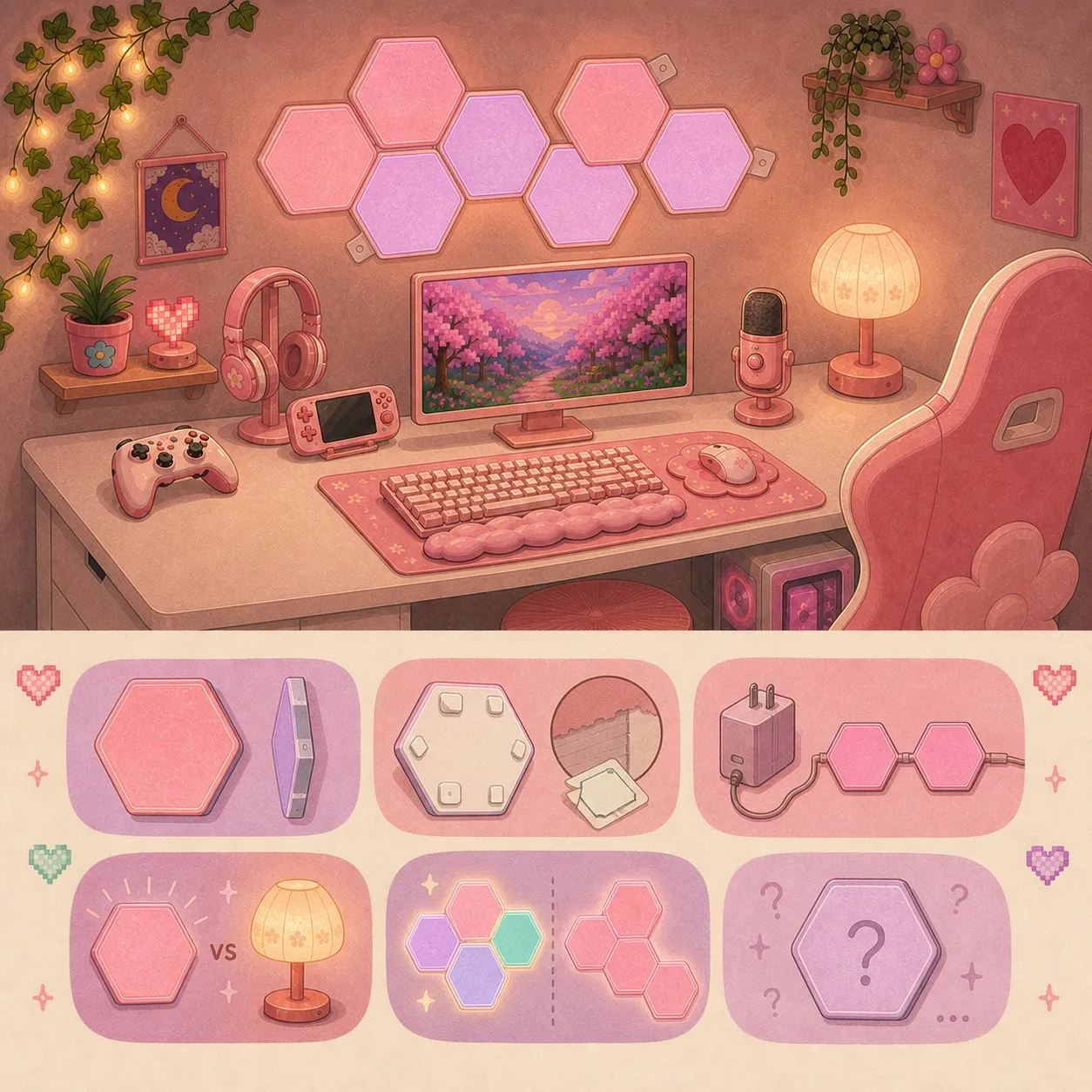
A hexagon LED light panel is a six-sided plastic tile with LEDs inside it that sticks to your wall, links to its neighbours and gets controlled from an app on your phone.
You buy them in kits, usually of five, seven, nine or ten. One panel in the chain carries the power and the controller, and the rest daisy-chain off it with little connectors.
The two brands that matter are Govee and Nanoleaf. Everything else on Amazon is a generic version of the same idea, which I'll come back to in point six.
Mine live above the desk, and over time I've ended up with a set from each of the two brands up there. I keep them low almost all the time, because softer looks cozier both in the room and on camera. At full brightness a room starts looking a bit like a nail salon.
1. Hexagons aren't proven better than any other shape
There's no published test showing hexagons work better than triangles, squares or lines. I went looking properly and came back with nothing.
The one person who reviewed all three Nanoleaf shapes side by side concluded it's a matter of taste, writing that "no matter what you do, they'll look good". No lux measurement, no coverage study, no uniformity data from anyone.
What the numbers do show is a trade-off, and Nanoleaf is the only brand publishing the same electronics in several shapes so it's the only fair comparison available.
| Shape | Lumens per panel | Watts per panel | Panels per power supply |
|---|---|---|---|
| Hexagon | 100 | 2 W | 21 to 22 |
| Triangle | 80 | 1.5 W | 28 |
| Mini triangle | 20 | 0.54 W | 77 |
So the hexagon is the biggest and brightest single tile, which means you cover a wall with fewer units and fewer connectors. It's also the hungriest, so you hit the power ceiling soonest.
There is one genuine hexagon advantage: six edges means six places a panel can link, so in theory you can grow a shape in any direction. Worth knowing that on the cheaper Govee Glide Hexa panels the wiring is one-in, one-out per panel, so every layout has to be a single unbranching chain and most of that freedom goes unused.
I picked hexagons because I like how they look. That's a completely fine reason and it's the honest one!
2. The adhesive can take your paint with it
This is the question nobody answers and it's the one that actually matters, especially if you rent.
I rent, so drilling was never really an option for me. Which means I picked the sticky problem over the holes problem, and I already know roughly what that wall is going to look like the day any of it comes down. I'd still make the same call. I'd just have liked somebody to say it out loud before I started.
Both brands mount with sticky pads. Owner reviews on both report the same thing:
- A gaming outlet reviewing Nanoleaf found the adhesive "isn't remotely renter-friendly, as carefully pulling one off took paint and plaster along for the ride"
- A Best Buy owner review of the Govee panels puts it more cheerfully: "Adhesive Pads work so good, they take off a very thin layer of paint/sheetrock"
- An independent test lab gave the problem its own heading, after a panel fell off within a week
It isn't universal... one tester left Nanoleaf panels up for weeks and got them off cleanly with a lot of tugging. It's common enough that I'd never call it a non-issue though.
Three things that genuinely help:
- Wait a week on fresh paint. 3M's own guidance is that paint should be fully cured, and they recommend waiting a week
- Skip wallpaper entirely. 3M says plainly that "most wallpapers are too delicate"
- Consider swapping the pads. A Nanoleaf hexagon weighs under half a pound, and Command Picture Hanging Strips are rated from 1 pound for the small size up to 16 for the large. Neither brand ships these or endorses them, so that's a decision you're making yourself
And plan the layout before you stick anything, because repositioning is destructive. Moving a panel usually costs you a fresh set of pads.
If screws are an option for you, Nanoleaf Blocks is the only panel system I found that ships with drywall and concrete anchors instead of relying on tape. Nanoleaf's own page has the mounting detail if you want it. Squares rather than hexagons, and it also does shelves.
3. There's a ceiling on how many you can run
There are actually two ceilings and the smaller one is the one that bites.
| Brand | Panels per power adapter | Panels in total |
|---|---|---|
| Govee Glide Hexa | 12 | 20 |
| Nanoleaf Shapes hexagons | 21 to 22 per 42 W supply | Up to 500 per controller |
Nanoleaf markets the 500. The number that decides your bill is the 22.
So going from a 10-panel Govee kit to 20 panels isn't just more panels. It's a second power adapter and a second wall socket, which changes where the whole layout can physically go.
Work out roughly how big you want the finished shape to be before you buy the starter kit, because that decides which brand suits you rather than the other way round.
4. They're dimmer than you probably think
A Nanoleaf hexagon puts out 100 lumens. For scale, ENERGY STAR puts a 60 watt incandescent bulb at 800 lumens.
So a nine-panel wall at full brightness is roughly one old-fashioned bulb's worth of light, spread across a wall rather than coming from a fixture. That's genuinely lovely as an accent... and nowhere near enough to be a room's main light.
Two more things reviewers consistently notice:
- The tips don't light up. The lit area has rounded corners, so the points of each hexagon stay dark and the tessellation never quite closes visually
- Pale colours look better than dark ones. Deep colours come out muddier, which is worth knowing if you had a specific moody shade in mind
Govee doesn't publish a lumen figure at all for its hexagon panels, which makes them impossible to compare to anything on paper.
None of this bothers me, because I never wanted them as a light. I wanted a glow behind the desk and that's exactly what they are. My cozy gaming lighting guide goes into how the layers fit together, and the monitor light bar is the thing doing the actual work on my desk.
5. RGBIC and RGBW are not the same thing
Every listing uses one of these acronyms and almost nobody explains them, so here's the plain version.
RGBIC means a single panel can show several colours at once. There are separately controllable segments behind the plastic, so one hexagon can fade from pink to lilac across its own face. Govee's panels do this, and reviewers have counted up to six colours simultaneously on one panel.
RGBW means a panel shows one colour at a time, with a dedicated white LED so its whites are proper whites rather than a mix. Nanoleaf Shapes works this way.
Which one you want depends entirely on the look you're after:
| You want | Pick |
|---|---|
| Gradients flowing across the wall | RGBIC |
| Clean single colours and good whites | RGBW |
| One panel doing a sunset by itself | RGBIC |
Neither is better. They're different effects, and it's the clearest real difference between the two big brands.
6. Cheap panels leave out the specs that matter
Search hexagon light panels and you'll find dozens of generic kits at a fraction of the price. Some of them are fine. The problem is that you can't tell which, because the listings leave out every number you'd use to compare them.
What the cheap kits typically don't publish:
- Lumens per panel
- Watts per panel
- Panel dimensions
- How many panels one adapter will drive
- What the adhesive actually is
That last one is the one I'd care about most, given point two.
To be fair, the big brands aren't perfect here either. Govee doesn't publish a lumen figure, a CRI figure or a colour temperature range for its hexagon panels. Its own product page doesn't even list the panel dimensions... three different published sources give three different sizes!
If you're on a tight budget, an LED strip behind the desk is the honest alternative. It costs a fraction as much, has no panel ceiling and washes a wall rather than sitting on it. It can't make a graphic shape, and that's the whole trade.
So are hexagon LED light panels worth it?
Yes, if you want a shape on your wall and you're honest that it's decoration. They're the fastest way to make a corner look intentional, they photograph beautifully and they cost almost nothing to run. At 2 watts a panel, my wall works out around five dollars a year.
No, if you're expecting them to light the room. One 60 watt bulb's worth of light across nine tiles is an accent, and a lamp will always do the job better for less.
Think hard if you rent. The adhesive is the real risk and repositioning is destructive, so plan the layout on the floor first and go in knowing what the pads might do on the way out.
Hexagons over triangles or squares is a taste decision and I'd stop looking for a technical reason. I picked mine because I like how they look, and honestly that's allowed :)
Hexagon light panel FAQ, the questions I get asked most
Do LED light panels damage your wall?
They can. Owner reviews of both Govee and Nanoleaf report the adhesive lifting a thin layer of paint on removal. It isn't universal, and it's common enough to plan around. Fresh paint should be cured for at least a week and wallpaper is a no.
How many hexagon panels do I need above a desk?
Six to nine covers a typical stretch of wall above a desk without dominating it. Buy the layout you want rather than the biggest kit, because more panels means more adhesive on the wall and a harder shape to redo.
Can hexagon light panels be the only light in a room?
No. One panel is around 100 lumens against 800 for a 60 watt bulb, so nine panels at full brightness is roughly one bulb spread across a wall. Lovely as an accent, not enough as a light.
Do hexagon lights use a lot of electricity?
Barely any. Nanoleaf publishes 2 watts per panel, so a nine-panel wall is 18 watts at full output. A few hours a day works out under five dollars a year.
Can I add more panels later?
Yes, until you hit the ceiling. Govee runs up to 12 panels per power adapter and 20 in total. Nanoleaf runs about 22 hexagons per power supply. Past those numbers you're buying another adapter, not just more panels.
Are cheap Amazon hexagon panels worth it?
Sometimes, and the problem is that you can't tell in advance. The listings tend to leave out lumens, wattage, panel size and what the adhesive actually is. If the budget is tight, an LED strip behind the desk gives you more light for less money and no panel ceiling.
What's the difference between RGBIC and RGBW?
RGBIC means one panel can show several colours at once, so you get gradients across a single tile. RGBW means one colour at a time plus a dedicated white LED for cleaner whites.
Are hexagons better than triangles?
No published test says so. Hexagons are the biggest and brightest single tile, triangles are cheaper per panel and you fit more per power supply. Pick the shape you like looking at.