What the Cozy Gaming Aesthetic Actually Is, and Where the Word Came From!
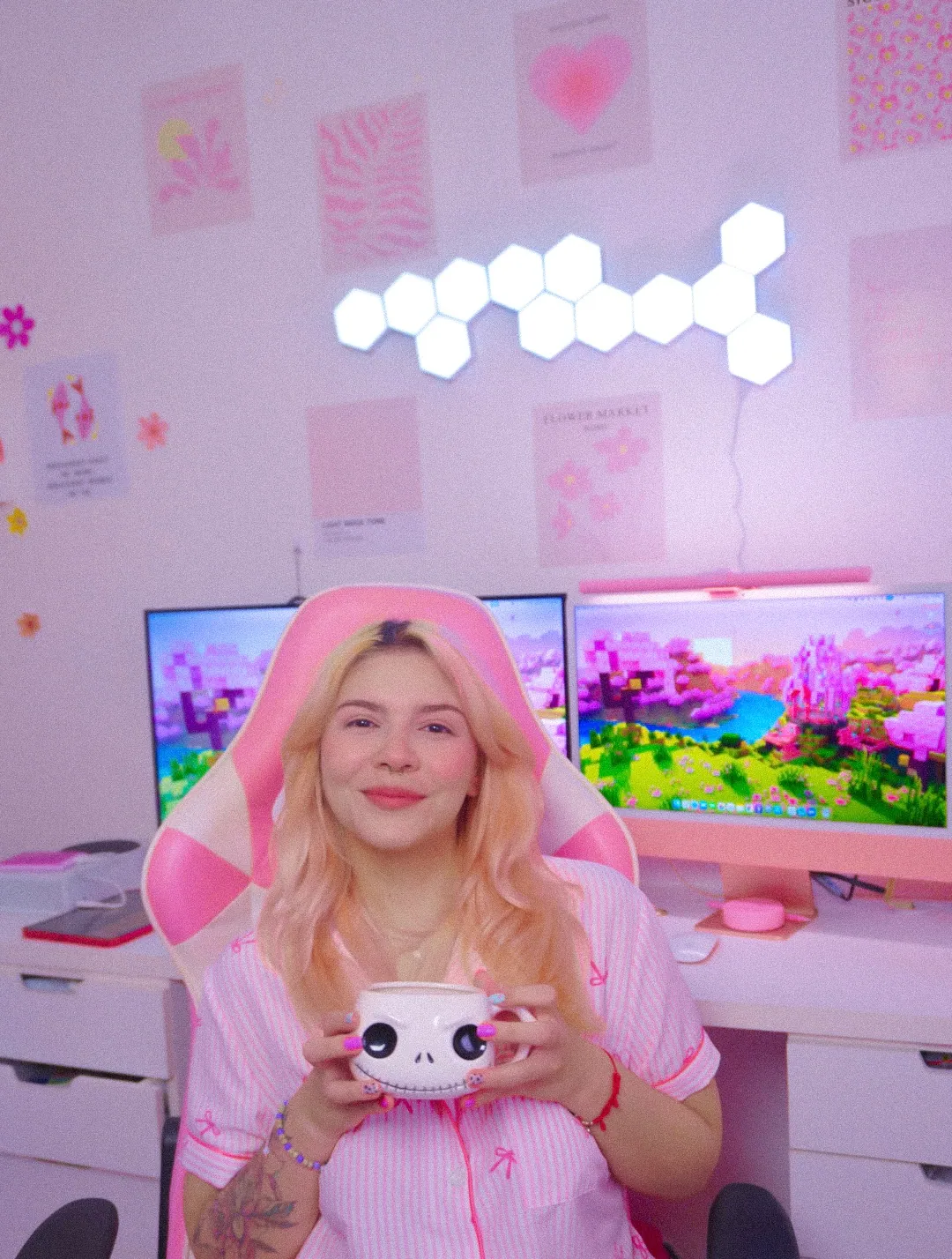
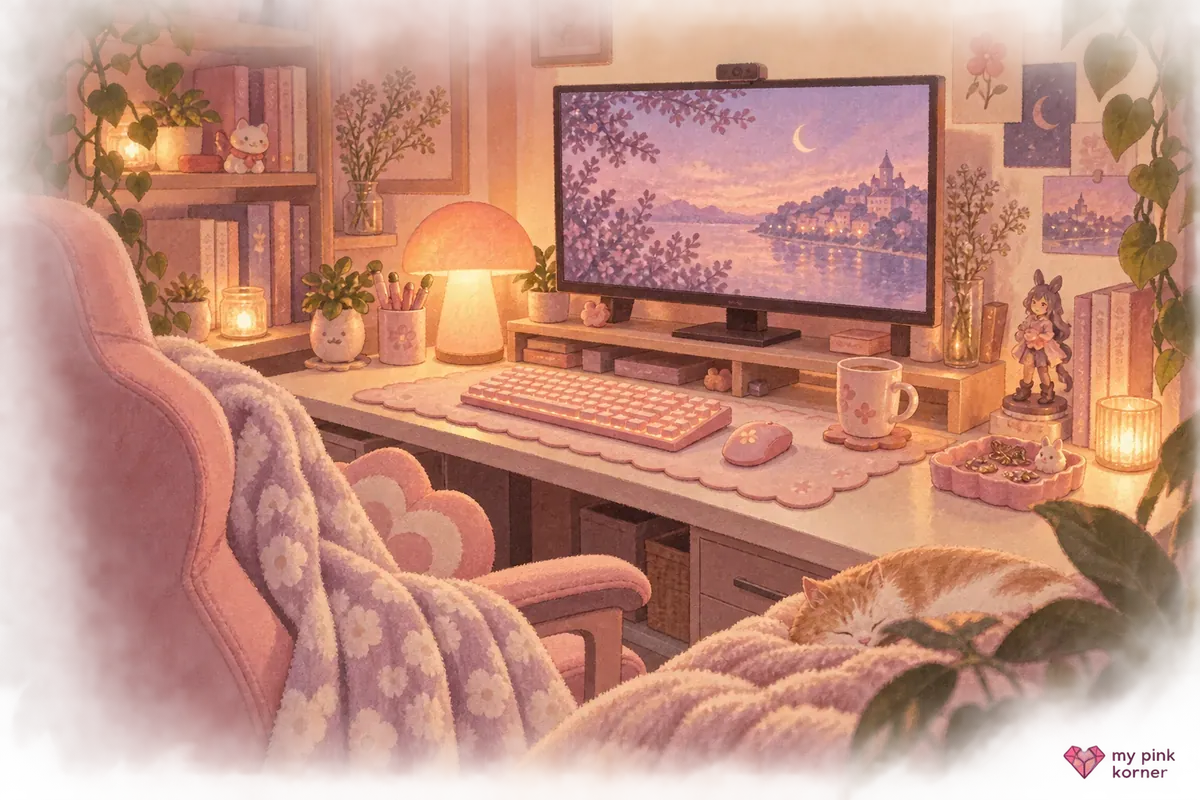
Every page that explains the cozy gaming aesthetic gives you a list of objects. Mushrooms, pastels, a blanket, a plush. None of them tells you where the word came from or why those three things in particular.
It does have an origin, and it's precise. A group of game designers wrote it down at an invite-only think tank in 2017 and gave it three components. Those three map almost exactly onto the three physical things a cozy desk is made of.
So this is the definition with its source, then the translation into a room. I have also put in the thing I found most surprising, which is that the rule everybody repeats about warm light traces back to one 1941 study that hasn't held up well.
🎀 A closer look from the corner
Watch this post on Instagram ↗
Where the word comes from, and who wrote it down
Project Horseshoe is an invite-only game design think tank, and its 2017 report includes a group paper titled Coziness in Games.
The authors are named and they're working designers: Tanya X. Short of Kitfox Games, Anthony Ordon and Joshua Diaz of ArenaNet, Dan Hurd of Playful Corp, Chelsea Howe of Owlchemy Labs, Jake Forbes of Star Stable, Squirrel Eiserloh of Rodents of Unusual Size and Daniel Cook of Spry Fox.
Their definition: coziness is how strongly something evokes a fantasy of three things. Safety. Abundance. Softness.
Cook republished the framework publicly on his own site in January 2018, with the same definition and one extra line I keep coming back to. Coziness, he wrote, is "relief and refuge and gentle opportunity."
Nobody in this corner of the internet cites it. The Wikipedia entry for cozy games doesn't name an origin and the top-ranking aesthetic pages have no citations at all. The most-repeated word in this niche has a documented author list almost nobody has read.
Hygge is in there too, and this part is interesting. Both the original report and Cook's version carry a reference link to a New Yorker piece about hygge. Neither one elaborates on it. The designers who defined cozy gaming pointed at hygge and then built nothing on top of it, which means the connection everybody assumes was thought through never actually was.
Denmark's own tourist board writes that hygge "means creating a warm atmosphere," and that "the warm glow of candlelight is hygge." Danish government material dates the modern sense to around 1800, from an Old Norse root meaning protected from the outside world. That's a better one-line summary of a cozy desk than anything written about desks.
Safety, abundance and softness, translated onto a desk
The three components were written about games. They translate to a room almost without editing, and this is the part nobody has connected.
| The 2017 pillar | Written as | On a desk it's |
|---|---|---|
| Safety | "an absence of danger and risk" | Low, warm, indirect light. Nothing harsh overhead |
| Abundance | lower Maslow needs "met or being met" | Small objects, visible and yours |
| Softness | "signals that tell players they're in a low stress environment" | Texture you can see and touch |
Safety is a lighting problem. An overhead ceiling light is the single most common thing making a bedroom setup feel like a place you work. Everything below about colour temperature is really about this.
Abundance is why an empty minimal desk never reads as cozy. Three perfect things on a bare surface reads as a showroom. A dozen small things reads as lived in.
Softness is the one most people get right by accident, because a desk mat and a chair cushion are things you buy for comfort anyway.
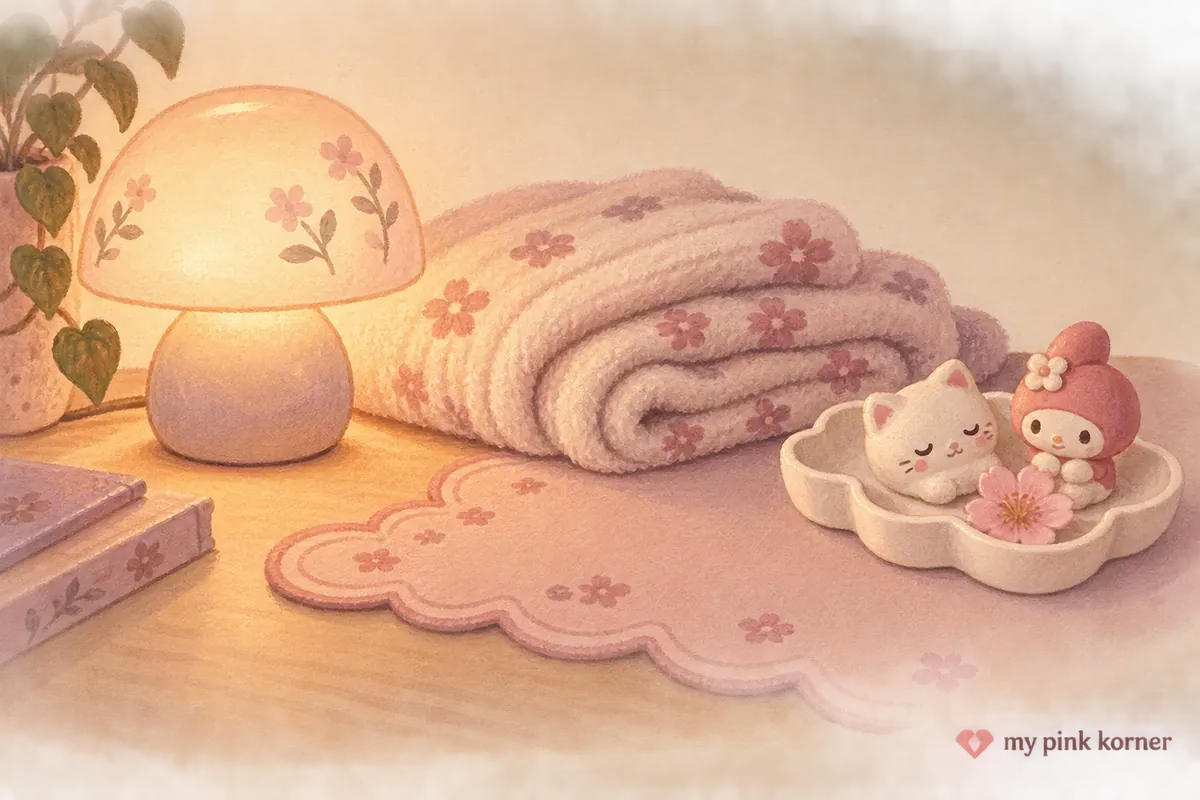
A cozy game and a cozy setup are two different things
These are two subjects sharing one word and almost every page collapses them.
A cozy game is a property of software, a Steam tag and a genre. The 2017 definition was written entirely about what happens inside the fiction.
A cozy setup is a room. it's tracked separately on social under its own hashtag, and the two numbers move independently.
You can play a cozy game on a harsh setup, and you can have a beautifully cozy setup and play horror on it. I do the second one regularly.
The clearest proof they're separate is that the publications covering this run two different articles, one on what makes a video game cozy and one on building a cozy setup.
Warm light, and the 1941 study everyone is quoting
Every cozy setup page tells you to use warm light. Almost none of them knows where that rule came from, and the answer changes what you should do with it.
It comes from the Kruithof curve. A. A. Kruithof published it in the Philips Technical Review in 1941, mapping combinations of brightness and colour temperature that observers rated as pleasing. At around 75 lux, roughly living-room level, the pleasing band sits at 2400 to 2700 kelvin. At 400 lux, office level, it widens to 3000 to 6000 kelvin.
Here's the part nobody mentions. Kruithof never described his evaluation method, his independent variables or his test sample. The curve has repeatedly failed replication. Modern studies don't find colour temperature to have a significant effect on comfort ratings, and their practical recommendation is mostly about avoiding very low illuminance.
So the honest version of the rule is this. Warm light is a preference, well supported as a preference and weakly supported as anything more. What matters more is how bright it is. A 2700 kelvin bulb at full output in a dark room still feels like an interrogation.
This is why the thing I actually do is keep everything dim rather than chasing a number. A plug-in lamp dimmer does more for a room than any bulb, because it turns every lamp you already own into a dimmable one.
Bulbs that get warmer as they dim are the best version of this. A filament bulb drops in colour temperature as it fades, and LEDs that copy it feel different from ones that only get dimmer. A Bulbrite warm-dimming LED that runs 3000K down to 1800K, a dim-to-warm A19 at 2000 to 2800K with 95 CRI and the Philips flicker-free Warm Glow bulb all do it. If you want one bulb that covers both moods, a GE colour-select A19 four pack switches between temperatures on the fixture.
The light I'd put on a desk isn't a bulb.A pink mushroom lamp with three colour temperatures, a stepless dimmable ONEWISH mushroom lamp, a small striped-glass bedside version or a cordless pink desk lamp with three temperatures all put a small pool of warm light at eye level, which is the thing the ceiling can't do.
For the glow behind everything, a 2700K COB strip with 90 plus CRI or a 95 CRI version of the same idea gives a continuous line of light rather than a row of dots, which is the difference between a shelf that glows and a shelf with LEDs stuck to it.
And the cheapest thing here's fairy lights.A 33 foot 100 LED set, a Minetom set, warm white curtain lights or a battery curtain set with a timer cover a wall for the price of one bulb.
Soft texture, and why it reads through a photo
Texture works through a photograph you can't touch, because people judge how a material will feel from how it looks.
Building-materials journals carry a real body of research on the perceived warmth of indoor surfaces, measured by sight and by touch. Vision does most of the work. That's exactly why a felt desk pad changes a photo of a desk when a hard plastic one doesn't.
It's also why the cheapest upgrade on any desk is the surface. A desk mat covers the largest flat area in the frame, so it sets the material story for everything sitting on it.
Felt and wool are the warm end.An XXL felt desk mat at 35.5 inches and a merino wool felt pad at 14 by 33 inches both photograph as fabric rather than as a surface. A scalloped pink desk mat and a smaller scalloped version add a shape to the edge, which does more than the colour does.
Leather and PU read as tidy rather than soft.An Aothia leather pad, a pink ENHANCE PU mat or a cork-backed YSAGi double-sided pad are what I'd pick for a setup that leans clean rather than soft.
Below the desk is where most people stop and shouldn't.A washable pink 5 by 7 rug does more for how a room sounds than anything else at that price, because hard floors are why small rooms echo. A cute flower plush floor pillow and a velvet meditation cushion are the two soft objects that earn floor space.
Curtains are the biggest fabric surface in the room.Light pink blackout curtains, a back-tab 52 by 84 version or a fully blackout pink pair at 52 by 63 change the light in a room twice a day, which no lamp does.
One warning before you buy the second pink thing. Two pinks bought from two sellers will very often not match, and there's a real mechanism behind that worth reading first.
Small objects, and why choosing them is the point
This is the best-evidenced of the three components and the finding isn't what you would guess.
The landmark study is Knight and Haslam, published in the Journal of Experimental Psychology: Applied in 2010. They ran four office conditions: lean, with nothing; enriched, decorated by someone else; empowered, where people chose their own decoration; and disempowered, where their choices were then overridden.
The empowered condition beat the professionally decorated one. Not the objects, the choosing.
There's a wider literature behind it. Wells wrote the foundational work on office personalisation in 2000. Byron and Laurence published a paper in the Academy of Management Journal that's literally about the small objects on a desk, with the word tchotchkes in the title.
What this means for a setup is freeing. The expensive version of a cozy desk isn't better than the version you assembled from things you already like. Nine of my favourite objects cost nothing, which is also the argument behind the 34 setup ideas post where a third of them are free.
What the objects need is a place to sit. That's the whole trick, and it's why loose things on a desk read as clutter and the same things on a tray read as a collection. A ceramic cloud trinket dish, a cloud jewellery tray or a shell-shaped ring dish give the small things an address.
Height is the other half. Objects all at desk level disappear into each other. Clear acrylic display risers and a three-tier acrylic figurine stand put a back row above a front row, which is the only reason shop displays look full instead of crowded. A small pink double photo frame and a silicone bunny night light are what I'd add if the shelf still looks thin.
One more piece of furniture is worth it if the desk is overflowing.An 11-cube reversible bookshelf gives the objects somewhere to live at eye level, and it's the change that stops a cozy desk turning into a cluttered one.
What it's not, measured against RGB
I want to be careful here, because there's no data showing people are abandoning RGB. What there is, is a measurable difference in how the two aesthetics are described.
Go and read a gaming lighting page. Govee's own gaming room guide advertises over 16 million colours and doesn't state a kelvin value anywhere on the page. BenQ's gaming lighting page carries no kelvin figure, no lux target and no CRI number. Both are about colour count and saturation.
Now read a cozy one. The vocabulary is colour temperature and brightness. Those are different axes, not different tastes.
The definitional argument is stronger than any trend claim. The 2017 report describes softness as signalling a low stress environment, "a lower state of arousal" while still engaged. High-saturation, high-contrast, music-syncing light is an arousal-raising signal by design. That's the actual conflict, and it's why RGB panels and a cozy room pull against each other even when both are pink.
This doesn't mean throw the panels out. Set them to one colour and turn them down, which is what I do with mine. More on that in whether LED light panels are worth it and in pink setup ideas that don't look cheap.
The one number that does support a real shift is from Steam. New games grossing over 100 thousand dollars that describe themselves as cozy in the store text went from 0.4 percent in 2022 to 3.1 percent in 2025, reported from GameDiscoverCo data. That's a 675 percent increase in three years and the largest keyword move in five years of that dataset. It measures cozy rising rather than anything declining, and that's the honest way to state it.
What I'd do first
Turn the ceiling light off and put one warm lamp on the desk.
That single change does more than any purchase on this page, and it's the safety pillar in one action. If the room has no dimmable lamp, a plug-in dimmer fixes every lamp you own for the price of a bulb.
Second, the desk mat, because It's the largest surface in every photo of your desk and it decides whether the setup reads as soft or as hard.
Third, a tray and a riser. Not more objects. Somewhere for the objects you already have, at two different heights.
What I wouldn't do: buy a colour-changing anything first. Don't chase an exact kelvin number and don't clear the desk down to three items because a minimal photo looked nice. Abundance is one of the three pillars and an empty desk fails it.
Starting from nothing, the 12 things that actually matter is the order I'd buy in. The weekend version is this whole article compressed into two days. For the light in front of you, the pink monitor light bar comparison covers that one fixture. How to hide cables on a small desk is what makes the soft surfaces visible.
Buying for somebody else? The cozy gaming gift guide is built from exactly these three components. Pink gaming gifts under 25 is where most of the small objects live. Everything I own is on my faves and there's more about me on my about page.
Cozy gaming aesthetic FAQ, the questions I get asked most
What's the cozy gaming aesthetic?
It's a room aesthetic built on three components borrowed from a 2017 game design report: safety, abundance and softness. In a physical space those become low warm light, a collection of small personal objects and visible texture.
Who invented the term cozy gaming?
It was formalised at Project Horseshoe 2017 in a group report called Coziness in Games, written by named designers including Tanya X. Short of Kitfox Games and Daniel Cook of Spry Fox. Cook republished the framework publicly in January 2018.
Is a cozy game the same as a cozy setup?
No. A cozy game is a genre of software defined by what happens inside the fiction. A cozy setup is a physical room. You can have either one without the other.
What colour temperature is cozy?
2700 kelvin is the usual answer and it reads as warm to most people. The rule traces to a 1941 study that hasn't replicated well, so treat it as a preference. Brightness matters more than the exact number.
Do I need to spend a lot to make a setup cozy?
No, and the research points the other way. In the Knight and Haslam experiment the people who chose their own decoration did better than the ones whose space was decorated for them. Choosing is the active ingredient.
Can I have RGB in a cozy setup?
Yes, set to one colour and turned down. The conflict isn't with the hardware. it's that high saturation and fast colour change are arousal-raising signals, which pulls against the softness component.
Is cozy gaming actually growing?
The clearest number comes from Steam. New games over 100 thousand dollars lifetime that call themselves cozy in the store description went from 0.4 percent in 2022 to 3.1 percent in 2025, a 675 percent rise and the biggest keyword move in five years of that data.