The 4 Types of Controller Skins, and Which Ones Are Worth It


In 2017 a skin company cancelled its entire Nintendo Switch range, refunded every pre-order and told people in writing not to buy a skin for their Switch. Their own product, their own words.
That's the most important thing that has ever happened in this little category and I couldn't find it mentioned on a single page that ranks for "do controller skins damage controllers".
So here's the honest version, type by type. Four different products get sold under the word "skin". One of them is a one-way decision and one of them will stop your controller sitting in its charging dock. And there is a much simpler answer than any of them, which nobody selling skins is going to tell you about.

The 4 things people call a controller skin
A controller skin is a decorative covering for a games controller, and the word covers four completely different products that behave nothing like each other.
| Type | What it is | How it goes on | Comes off? |
|---|---|---|---|
| Vinyl decal | An adhesive sticker cut to the controller's shape | Sticks to the shell | Once. See below |
| Silicone cover | A moulded rubber sleeve | Stretches over. No adhesive at all | In seconds, over and over |
| Hard shell | A replacement plastic housing | Screws and tools. You take the controller apart | Only by taking it apart again |
| Console wrap | The same vinyl, cut as a set for console plus controller | Sticks on | Once |
Those four differences are the entire article and I couldn't find a single page in the search results that separates them. Most of them lump vinyl and silicone together in one sentence and then compare neither.
A quick note on a fifth thing, because it confused me for a while. If you search "what is a controller skin" you'll get an emulator app's help page near the top, because emulators call their on-screen button layouts skins too. Different thing entirely.
And I'd rule out the hard shell right now if you're anything like me. Replacement shells ship with screws and tools and require full disassembly of a controller with a battery in it. It's the one type in this whole category that is genuinely a modification rather than a decoration.
Will a skin damage your controller?
The honest answer is that it depends entirely on who made it, and there's a documented case proving it.
The time a skin company told people not to buy its skins
In March 2017 dbrand, one of the biggest names in vinyl skins, cancelled its whole Nintendo Switch line and refunded every pre-order. Their statement, after their own testing: "After removing the skin, it was obvious that the coating on the JoyCons do not play well with any kind of adhesive." They said the same was true of the console. And then, plainly: "Do not buy a skin for your Nintendo Switch."
Reporting at the time noted the coating started peeling after only a few applications, and that this happened even using the lowest grade of adhesive the company could work with.
That is a company with every commercial reason to say the opposite, saying it anyway. It settles the question of whether an adhesive skin can lift a factory finish. It can.
And the part that matters just as much
dbrand didn't walk away. They spent over a year working with 3M on a new adhesive and relaunched Switch skins in April 2018, saying the new ones were safe. Today their product pages state that removal is guaranteed to leave behind zero adhesive residue.
So the risk is real and it's specific to the adhesive and the device's factory finish. It's a solved problem for the companies that solved it. It isn't solved generically, which is exactly why the brand you buy matters more here than in almost any other category.
The disclaimer nobody quotes
Skinit, another big vinyl maker, says on its marketing that skins are safe. Its own support base says something narrower. Their skins "should not damage your device". Then, in the same document: "Skinit shall not be responsible for replacing any devices due to paint chipping, peeling, or removal of any coating."
Read those two sentences together and you have the actual position of the industry. Should not, not will not. And the exact failure you're worried about is the exact failure they exclude.
One more from the same company, because it's useful: they won't predict how long a skin lasts, saying the length of time is unpredictable and depends on how the device is handled.
And what does removal actually look like
Residue is a brand question, not a myth question. One manufacturer guarantees zero. Another says "little or no". The gap between those two phrases is the whole thing.
On the hairdryer trick: you'll see it everywhere and it's worth knowing that no skin manufacturer I could find recommends it. It's retailer advice. That doesn't make it wrong. But applying heat to a controller with a lithium battery inside it is advice nobody with any liability has put their name to, and I'd rather tell you who's actually saying it.
Vinyl is single use, and nobody says so
This is the single most useful thing on this page and it's hiding in a manufacturer's support pages.
Skinit's own words: "Once removed, however, the Skin will never again adhere quite as well as the first time." And more directly: "We do not recommend removing the Skins to be reused again since our Skins are made for one-time application." Reapplying also risks stretching the vinyl.
So a vinyl skin is a one-way decision per skin. Take it off and that one is finished.
Which means the real question isn't which pattern you like. It's how often you change your mind. If you redo your desk every few months, and honestly a lot of us do... buy silicone. A silicone cover stretches on with no adhesive at all and comes off in about four seconds. Mine has been on and off more times than I want to admit and it's fine.
And the pink has held up perfectly, which is the bit I actually get asked about. Months on, no fading, no yellowing, no lifting. It still sits right next to the rest of the pink on my desk. The one caveat is that I don't handle it with dirty hands, and I suspect that's most of it.
If you know exactly what you want and you want it flush and thin, vinyl is the better looking result. Just go in knowing it's once.
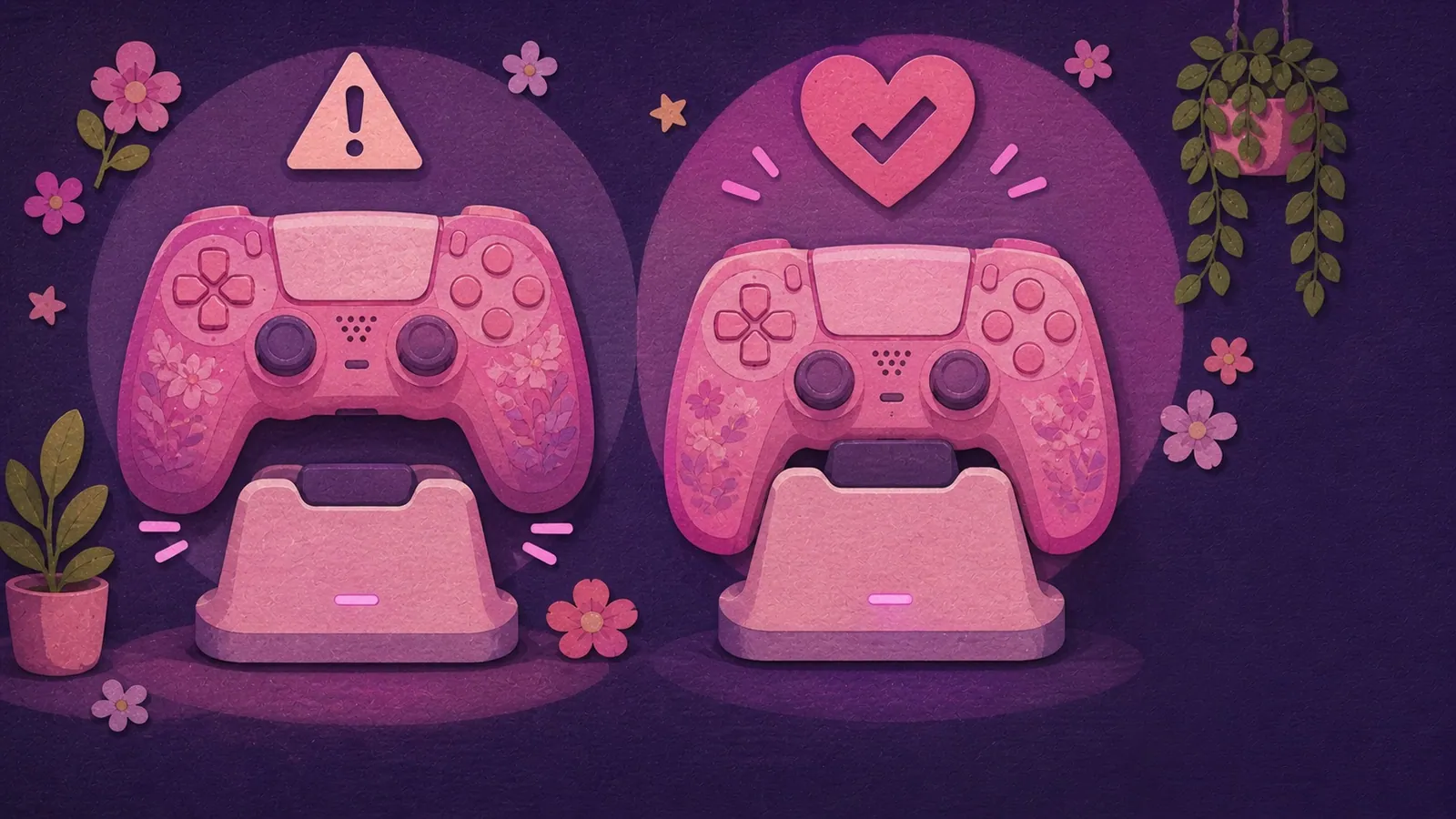
Will it still fit in the charging dock?
Probably not, if it's a standard silicone cover, and here's how I worked that out.
PlayVital sells a Cherry Blossoms Pink cover and, separately, the same colourway in a "Dockable Model" that says it fits with a charging station.
Nobody sells a paid dockable version of a product that already docks.
That's me reading a product line instead of quoting a spec sheet, so take it as an observation and not a fact. But if you charge on a dock, buy the dockable one. If you charge with a cable it doesn't matter at all.
Vinyl doesn't have this problem because it adds almost no thickness. That's a genuine point in vinyl's favour and it's the only one on this page.
Do controller skins cause stick drift?
No, and there's proper evidence for that.
Stick drift is when a controller registers movement on a stick you aren't touching. Two independent teardowns have looked at why.
iFixit took apart a DualSense and found the cause inside the stick module: a small metal contact called a wiper slides along a printed carbon track, and the track wears. The component maker rates those parts at two million cycles, and iFixit calculated that heavy use could get you there in four to seven months. The four causes they identified were sensor wear, spring fatigue, material stretching and debris getting inside.
A separate microscope autopsy of a drifting stick found gouges in the resistive material, caused by the metal contacts inside the analog stick, from normal use.
Neither one mentions skins, covers or grip caps anywhere. The failure is inside a sealed module, driven by how many times the stick has moved. A layer of rubber on the outside of the shell cannot reduce that.
The one page I found claiming skins help with drift is written by a controller repair company, and the mechanism it proposes doesn't survive contact with either teardown.
Does a skin void your warranty?
Nothing I could find says a decal or a rubber cover voids anything. I want to be careful about how I say that.
Nintendo publishes its warranty and I read it. It excludes damage caused by parts or repairs not authorised by Nintendo, and damage caused by unauthorised modifications or tampering. Read honestly, those exclusions are about damage caused by a modification, not about a decorative item being present. A stretch-fit rubber cover modifies nothing. A sticker is not a part or a repair.
A hard shell replacement is a different matter. That one is a physical modification requiring disassembly, and it's the only type on this page with an obvious route into that clause.
On Sony and Microsoft, I'm going to be honest with you: I couldn't verify their exact wording. Sony's warranty page wouldn't load for me and the Xbox terms were only available through a mirror I couldn't reach. Instead of paraphrasing somebody's blog summary, I'd rather tell you the leaflet in your own console box is the version that counts.
Or you could just buy the pink controller
Here's the thing no page selling skins is going to tell you.
All three platform holders make a first-party pink controller. Sony has the DualSense in Nova Pink. Microsoft has the Xbox Wireless Controller in Deep Pink, which has been in the line since January 2023. Nintendo has Joy-Con in Pastel Pink, revealed in January 2024. Worth knowing before you order: those are original Switch Joy-Con, and the Switch 2 attaches its controllers magnetically instead of on the rail.
No adhesive. No fit question. No dock problem. Nothing to remove later. The pink is the plastic.
I have the Deep Pink Xbox controller and it's the pink thing on my desk that has caused me the least thinking of anything I own. If what you actually want is a pink controller rather than a pink pattern, that's the answer and it took me an embarrassingly long time to work that out.
Skins still win on two things. They give you a pattern instead of a flat colour, and they let you match a controller you already own without replacing it. Both are good reasons. Just make sure the reason is one of those two.
There's no first-party pink console shell for every model, which is where wraps genuinely earn their place. Mine is on my Xbox Series S, using a full console and controller vinyl set. It's the only way I've found to get a console body to match a desk. I'll go deeper on the Xbox and PlayStation options in their own posts soon.
Which one I'd actually get
Silicone, if you're not sure. It comes off, it goes back on and it costs your controller nothing at all. It's the only type where changing your mind is free. Get the dockable version if you charge on a dock.
Vinyl, if you know what you want. It's thinner, it looks better and it doesn't interfere with anything. You get one go at it. Buy from a brand that publishes what it promises about residue, because that's the whole difference between a good outcome and a bad one.
The pink controller, if what you wanted was a pink controller. Which is more often than anybody selling skins would like to admit :)
Not the hard shell, unless taking a controller apart sounds fun to you rather than terrifying.
One last honest note. Nobody has independently tested whether any of these actually protect a controller. Not one drop test, not one abrasion test, anywhere in the whole category. A silicone cover puts a layer of rubber between your controller and the floor and that's just geometry, so it presumably helps. But if somebody tells you a skin protects your controller, ask them who measured it.
Controller skin FAQ, the questions I get asked most
What is a controller skin?
A decorative covering for a games controller. The word covers four different products: an adhesive vinyl decal, a stretch-fit silicone cover, a hard replacement shell and a full console wrap kit. They behave completely differently and the one you want depends on whether you plan to change your mind.
Do controller skins damage controllers?
An adhesive skin can lift a factory coating, and there's a documented case of exactly that. In 2017 dbrand cancelled its Nintendo Switch skin line and told customers not to buy one, after finding the adhesive damaged the Joy-Con coating. They later re-engineered the adhesive with 3M and relaunched. A silicone cover uses no adhesive at all and cannot do this.
Can you take a controller skin off and put it back on?
Not a vinyl one. The manufacturers say vinyl skins are made for one-time application and will never adhere as well again. A silicone cover comes on and off as many times as you like.
Do controller skins cause stick drift?
No. Two independent teardowns locate the cause inside the stick module, at a metal contact wearing a printed carbon track rated for around two million cycles. Neither mentions skins, covers or grip caps.
Does a controller skin void the warranty?
Nothing I could verify says so for a decal or a rubber cover. Nintendo's published warranty excludes damage caused by unauthorised modification, which is about damage rather than decoration. A hard shell replacement is a genuine modification and is the one type where this is a real question. Check the leaflet in your own console box.
Will a silicone cover fit in the charging dock?
Often not. At least one brand sells a separate dockable version of the same cover, which strongly suggests the standard one doesn't fit. Vinyl adds almost no thickness and doesn't have this problem.
Is there an official pink controller?
Yes, on all three platforms. Sony's DualSense comes in Nova Pink, Microsoft's Xbox Wireless Controller comes in Deep Pink and Nintendo sells Joy-Con in Pastel Pink. If a pink controller is the goal, that's a simpler route than a skin.
Do controller skins protect the controller?
Nobody has tested it. There is no independent drop test or abrasion test anywhere in this category and every protection claim traces back to somebody selling skins. A silicone cover adds a physical layer of rubber, which is self-evident. Beyond that, treat it as decoration.